

ProLogium Begins Mass Production of High-Energy-Density All-Solid-State Battery, Reaching 381 Wh/kg and 903 Wh/L
TÜV validates Gen 3.5 energy density; UL Solutions testing supports all-solid-state classification under GB/T 43568-2026. More than a decade of commercial production underpins a scalable Giga-level platform extending to Gen 4’s fully inorganic electrolyte system.
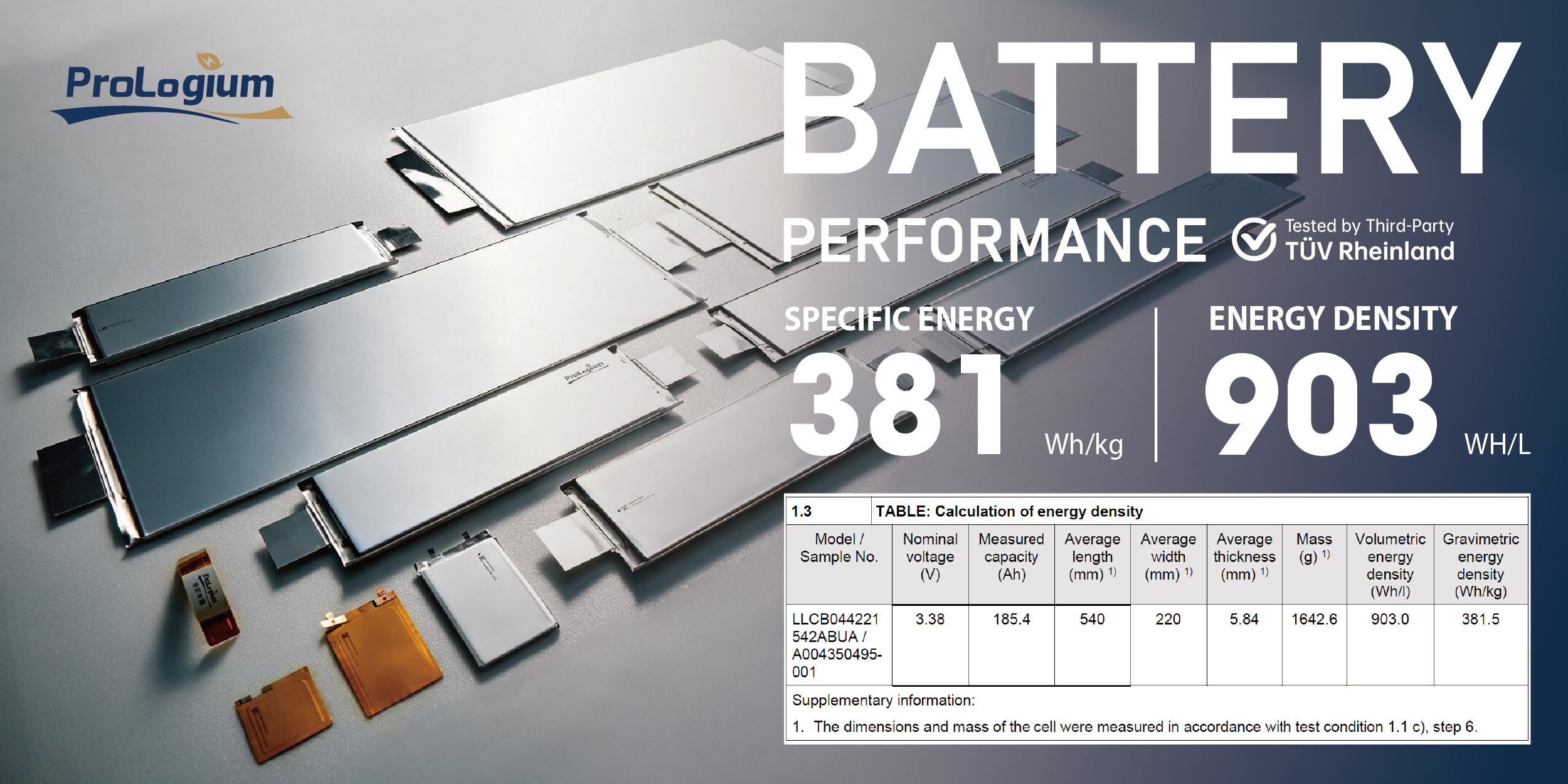
TAIPEI, Taiwan, Sept. 02, 2026 (GLOBE NEWSWIRE) -- ProLogium Technology said its Gen 3.5 Lithium Ceramic Battery (LCB) is now in mass production at its Giga-level manufacturing facility in Taiwan, moving high-energy-density all-solid-state battery technology beyond laboratory and pilot-scale development.
A third-party TÜV test report showed that ProLogium’s 185.4 Ah large-format cell reached 381 Wh/kg gravimetric energy density and 903 Wh/L volumetric energy density, reducing the weight and volume required for a given amount of stored energy while supporting high-power and fast-charging applications.
Separately, UL Solutions tested the cell under China’s GB/T 43568-2026 methodology. After six hours under vacuum at 120°C, the cell recorded weight loss of less than 0.05%, well below the 0.5% maximum threshold for all-solid-state classification. The cell can therefore be classified as all-solid-state under the standard. GB/T 43568-2026 has also been submitted to the International Electrotechnical Commission (IEC) as a reference for international standardization.
Unlike solid-state battery programs that remain at laboratory or Pilot Line scale, the Gen 3.5 Lithium Ceramic Battery is built on ProLogium’s Logithium™ cell architecture, which defines the corresponding scalable manufacturing process – together forming the industrial platform of Lithium Ceramic Battery.
The LCB platform was defined in 2012. Since then, ProLogium has continuously advanced its battery technology, improved the efficiency of its manufacturing processes, and successfully commercialized its products, resulting in 4 generations of battery technology and three generations of manufacturing technology.
Since commercial production began in 2013, ProLogium has shipped more than 2.4 million cells on the LCB platform, building a manufacturing track record spanning consumer, specialty and automotive applications.
Logithium™: The Cell Architecture Behind Scalable Production
ProLogium completed the core design and patent groundwork for its Logithium™ Cell Architecture in 2012. The architecture combines a Ceramic Separator with a proprietary edge-frame structure, creating an additional separator around the electrode perimeter to help isolate potential burrs while providing sealing and insulation.
The architecture has remained the foundation of ProLogium’s LCB platform as electrolyte chemistry and active materials have evolved.
In 2013, ProLogium began commercial production on its first-generation Sheet-by-Sheet line, initially targeting higher-margin niche markets including consumer electronics, wearables, explosion-resistant applications, medical devices and semiconductor equipment.
The strategy allowed the company to fund and refine its early manufacturing ramp-up through commercial orders, accumulating experience in process control, yield, quality and customer delivery.
In 2017, ProLogium introduced its second-generation Roll-to-Roll line, moving into continuous manufacturing with higher automation, throughput and consistency.
In 2024, its third-generation Giga-level platform entered operation, scaling more than a decade of manufacturing experience into large-format cell production and providing the production data needed to further improve yield, consistency and equipment stability.
Rather than making a single jump from Pilot Line to GWh scale, ProLogium has progressively expanded its manufacturing capability through commercial production, with each generation building on the process experience and quality data of the previous one.
ProLogium’s Manufacturing Evolution Video: https://www.youtube.com/watch?v=VsJUIytVIcg
Automotive Orders Validate Manufacturing Track Record
ProLogium obtained IATF 16949 automotive quality-management certification in 2022 for its operating production line and has continued to pass annual surveillance audits.
Backed by a stable and proven manufacturing platform, ProLogium’s LCB are supplied to a well-known U.S. automotive audio-system company and installed in vehicles from a Japanese automaker ranked among the top three in North American sales.
The customer has placed more than 175 repeat orders, with cumulative deliveries exceeding 900,000 cells, and plans are underway to expand the application from North America into the Asia-Pacific market.
The recurring orders provide long-term validation of product consistency, manufacturing reliability and delivery performance beyond one-time prototype or Pilot Line testing.
ProLogium has also entered the Unmanned Systems market and secured orders for applications requiring high energy density, high discharge capability and fast charging to improve payload, endurance and recharge time.
One Manufacturing Platform Across Battery Generations
A central feature of the Logithium™ architecture and LCB platform platform is its ability to accommodate new materials and electrolyte systems without rebuilding the manufacturing foundation.
The Ceramic Separator architecture has remained the foundation of ProLogium’s Logithium™ architecture and LCB platform, while its Composite Solid Electrolyte system has evolved by progressively reducing organic electrolyte content.
As electrolyte chemistry and active materials change, the core Cell Architecture, major manufacturing processes, equipment base and accumulated manufacturing know-how can largely be carried forward.
This allows ProLogium to upgrade battery chemistry without resetting its industrialization capability with each technology generation.
Gen 4 LCB : Whole New Chemistry. Same Platform.
ProLogium’s Gen 4 LCB, featuring a fully inorganic superfluidized electrolyte system, retains the same Logithium™ Cell architecture and manufacturing process.
The company expects that only about 10% of its existing Giga-level production line and related equipment will require modification to manufacture Gen 4 cells.
The new generation is designed to retain the platform’s high energy density, high-power and fast-charging performance while adding ProLogium’s ASM, or Active Safety Mechanism, designed to prevent thermal runaway by actively stabilizing electrode active materials at high temperature conditions. Gen 4 is also expected to improve low-temperature performance and reduce material and manufacturing costs.
ProLogium is targeting AI data centers, electric vehicles, maritime and aerospace applications with the technology.
The ability to move from Gen 3.5 to Gen 4 while retaining most of the existing manufacturing system is central to ProLogium’s platform strategy: battery chemistry can evolve without rebuilding industrial capacity from the ground up.
From Taiwan and France to North America
ProLogium plans to build a global manufacturing network with Taiwan serving as its technology-development and manufacturing-validation base, France supporting scaled production, and North America progressively adding localized supply and manufacturing capacity.
In North America, the company is considering a phased localization strategy initially targeting Unmanned Systems, Aerospace and AI Data Centers.
Under the first phase, ProLogium will evaluate partnerships under which Inlays —the core single layer unit of LCB cell, based on ProLogium’s Logithium™ architecture — would be produced at scale in France and shipped to North America, where collaborated partners can efficiently assemble inlays into pouch cells through simple direct stacking, followed by module and pack integration closer to end customers. As demand grows, ProLogium will also evaluate establishing Inlay production capacity in the United States in the next stage.
A similar model could be applied in Asia-Pacific, with the Taiwan Giga-level facility serving as an Inlay production base and regional partners supporting downstream manufacturing and market expansion.
From three generations of manufacturing scale-up to Gen 3.5 all-solid-state production and the planned Gen 4 fully inorganic system, ProLogium has spent more than a decade building a scalable battery manufacturing platform designed to accommodate technology upgrades and be replicated across regions.
The company plans to combine its manufacturing base in Taiwan, scaled production in France and phased localization in North America to support the broader commercialization of next-generation high-performance batteries.
A photo accompanying this announcement is available at https://www.globenewswire.com/NewsRoom/AttachmentNg/57bfe6c3-8a6f-4619-8923-9ded7e62cb65

Contact

Sam Chang

Sam@prologium.com

A third-party TÜV test report showed that ProLogium’s 185.4 Ah large-format cell reached 381 Wh/kg gravimetric energy density and 903 Wh/L volumetric energy density
Reducing the weight and volume required for a given amount of stored energy while supporting high-power and fast-charging applications
Legal Disclaimer:
EIN Presswire provides this news content "as is" without warranty of any kind. We do not accept any responsibility or liability for the accuracy, content, images, videos, licenses, completeness, legality, or reliability of the information contained in this article. If you have any complaints or copyright issues related to this article, kindly contact the author above.
